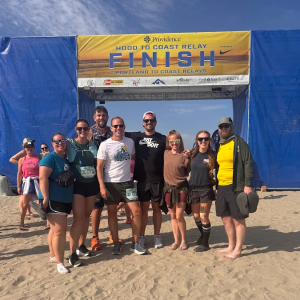
This year, Team RunRunner Jason completed his epic goal of running the Hood to Coast Relay in 34 hours! As a part of a small team, Jason ran a total of 9 legs and 50 miles over the two day event. The 2025 Hood to Coast will be remembered for being the hottest edition to date being the hottest one to date, with temperatures soaring over 100 degrees Fahrenheit.
Following the event, he wrote up this wonderful race recap, and shared this: “There’s no way I would have been able to do this, and recover as quickly as I did, without the gradual build up in mileage that TRR Coach Brian Comer has had me doing in preparation for a sub 3-hour marathon. At over 50 years old, I have more endurance now than ever before in my life!”
On the Springwater Trail
I heard a pop, almost like a whistle, before my right foot felt like it was getting pricked every time I ran a step. For sure, I thought I had stepped on a nail. I kept on running anyway, which didn’t work; the nail kept pricking at my foot. I knew I’d have to stop. Sort this out. The problem was that I was running the Hood to Coast Relay and the temperature in Happy Valley, Oregon, was over 100 degrees. I was on the Springwater Corridor, a remote section of the blackest asphalt, and it felt like running on the sun. The last thing I wanted to do was stop and prolong this experience–with no shade. No access for cars. My team couldn’t help. And I was all out of water.
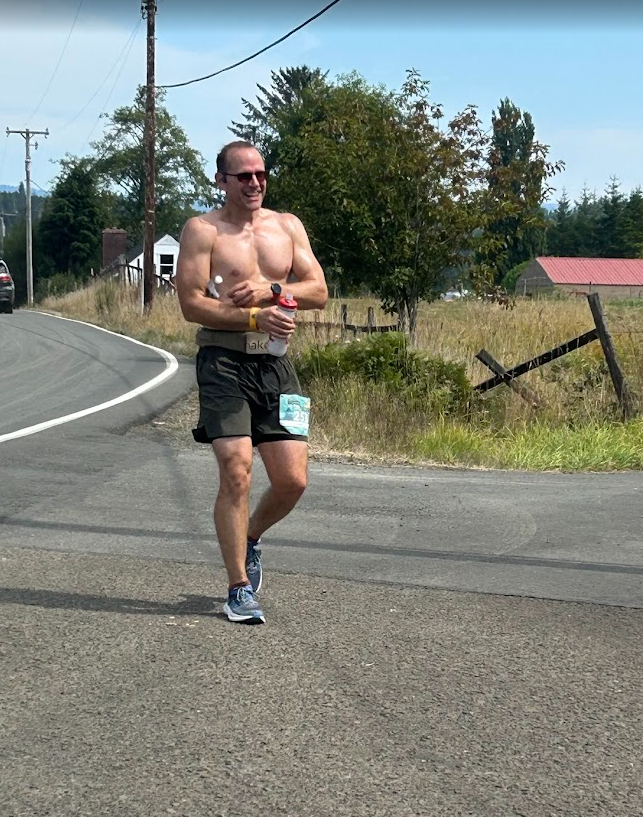
Oh, and I had about 44 miles to go in the next few days–because I was running the “The Mother of All Relays” in a team of only three people. I had just run Leg 9 and was now three miles or so into Leg 10, which was essentially the start of the relay for me.
Back to reality…
I already felt laid out.
So I sat down beside the trail, on the dead dry grass, and took off my shoe. I inspected the bottom. It wasn’t a nail. It was a stout little wooden sliver, almost an inch long. No blood. It didn’t pierce my skin, which was nice. Except I couldn’t quite pinch it out of the bottom of my shoe with my finger nails, either. This was a big problem. I tried to bite it out with my teeth, before I realized how this looks to other runners: some shirtless, half-naked man with his short-shorts on, eating his own shoe. They’d think the heat really got to me.
Eventually, after about 20 minutes of fiddling with it, I slowly but surely pushed and wiggled the sliver out. When I stood back up, I almost passed out. I now had 3 miles to go to the next exchange, if I didn’t die.
Heat exhaustion (if not death) was a real concern.
This is certainly an issue when the ambient temperature is over 100 degrees and you are running on asphalt, which absorbs the heat and cooks your feet and body from below. Even my water bottle ended up scalding to my own touch. I could tell how close I was getting to the next exchange from the ambulance sirens getting louder and louder.
Our Hood to Coast (H2C) Team: The Running Yeti Its
H2C teams have a long tradition of creative names and we were the “Running Yeti Its.” I was the main Yeti It (which sounds like “idiot”) because I had decided to run nine legs in what turned out to be the hottest Hood to Coast since the race’s inception in 1982.
Normally, runners ran three legs each for a total of 14-17 miles each over two days, Friday and Saturday. This time, I didn’t want to spend so much time in a van. Since the only other option was running, and someone had dropped out with a broken toe, I was “runners” 4 in Van One, as well as 9 and 10 in Van Two, for a total of close to 50 miles. This meant that I would transfer vans at each major exchange, leaving very little time for sleep. I thought this would be fun and exciting, and it was–until the sun fully came out and I was marooned on the hot asphalt trail eating my own shoe.
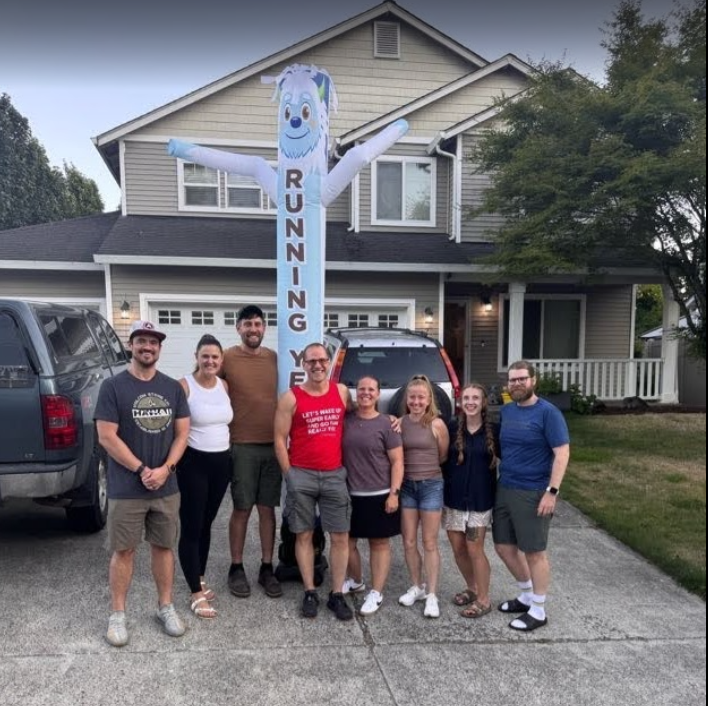
We had eight people on our team for a relay that took us 196 miles from almost the top of Mount Hood to the city of Seaside, Oregon. See the picture to the right for us in front of our Air Dancer Yeti It mascot before the event.
From left to right in the picture:
- Casey “Who’s Going to Carry the Boats” Carroll
- Jessica Bailey, our superstar HR event organizer and Team Captain, my sister, and pregnant but doing this anyway
- Aaron Schoknecht, Jessie’s husband, who was tall enough to be an alt Yeti It mascot by throwing up his hands at exchanges so we could always find our people
- Jason Hagen (me)
- Stephanie Hagen, my other sister and Van Two “mom” with 25 years of experience as an EMT, which made us feel safer
- Adria Biasi, our physical therapist who kept Jessica and I running, overcoming niggles and injuries. We couldn’t have done this without her. And her ultramarathon friends (and our new friends) from Seattle:
- Jocelyn O’Donnell who had run 80 miles to be the overall winner of the One Step Closer 18 hour ultra in Seattle, WA, the weekend before H2C and had the severe blisters to prove it
- Walter Hicks, finisher of the Cascade Crest 100
In the above picture, on my red tank top, it said:
Let’s Wake Up Really Early and Run Super Far. – Psychopaths
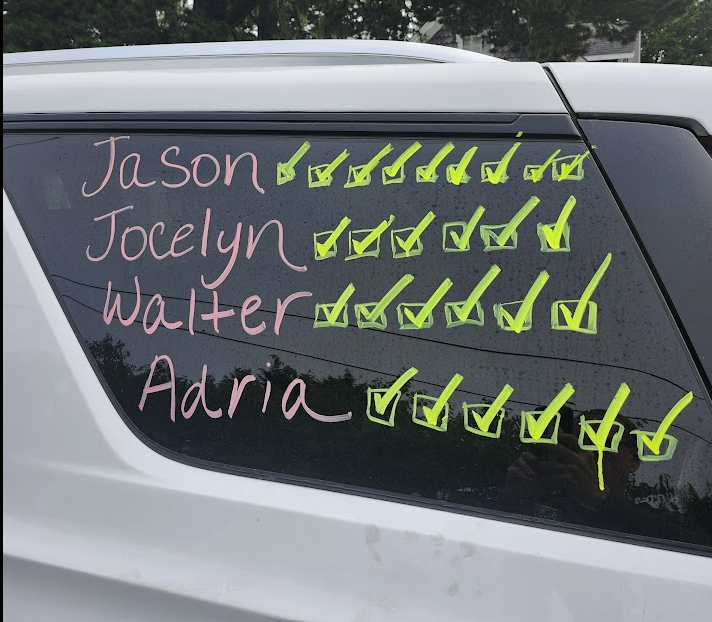
Luckily, we could get away with 8 people instead of the recommended 12 because we had three people running 6 legs or more: Adria, Jocelyn, Walter and I (Jason). The four of us made up Van One, while myself and Adria ran in both Van One and Van Two.
Running Yeti Its’ Team Strategy
My family has been doing H2C yearly since 2023, and I had run as two people the year before. This time, I wanted to bridge the vans as a runner in both Van One and Van Two. Adria was willing to try this as well. Jocelyn and Walter represented two runners (six legs each) and remained in Van One with us.
Two things changed the game this year when bridging vans: basically no sleep, and then the heat. When you bridge vans, you do not have much time to sleep because you are always just finished running or preparing to run again throughout the day and night. With the heat, you need to slow down to avoid heat exhaustion. This makes pacing, hydration, and calories key to feeling okay (or maybe just blazay) throughout the relay.
Running Multiple Hood to Coast Relay Legs: My Pacing Plan
For pacing, I tried to keep my heart rate below 130 bpm as a general guideline. A simple rule of thumb for estimating your maximum heart rate is to subtract your age from 220. As a 50-year-old man, my estimated max would be roughly 170 beats per minute. I wanted to remain at a solid “zone 1” or “zone 2” pace, staying well below my max effort.
After I was through Friday’s heat wave, however, I had discussed with my awesome Team RunRun Coach, Brian Comer, how it would be all right to pick up the pace on Saturday. So, on Saturday night at around 2am, on some nice downhills with my heart rate hovering around 120 bpm at a pace of around 9-9:30 minutes per mile with a cool breeze, I decided to “send it,” to speed up, to get up and GO–but I didn’t. Physically, I couldn’t. This was odd. My brain and legs struggled to understand each other.
My Brain: Let’s go! Let’s do this. Come on!
My Legs: Go to hell.
My Brain: There’s plenty of bpm room here to speed up and Brian said I could.
My Legs: No. You don’t know me. I know me.
My Brain: Come on, you pussies!
My Legs: You need to run H2C again in a matter of hours, another 16 miles, you idiot.
My Brain: Oh, yeah.
My Legs: Dude. Stop reasoning. I got this.
Fueling The Hood to Coast Relay
I ate like a toddler or an elderly man on hospice (pick your analogy on either side of that spectrum). Immediately after each run, I drank an Ensure Plus for 350 calories after each run. This was usually followed up with grapes, bananas, Pedialyte, and a lot of water, constantly sipping. I still ended up dehydrated.
Solid foods were minimal, mostly consisting of what I called “Yeti It Pizza”: peanut butter, banana slices, and crushed M&Ms sandwiched inside of two tortillas, cut like pizza. The only ‘super solid food’ I ate were bagels with cream cheese that Adria thankfully made for me. While I had to keep the solid food light to keep my stomach in check, I knew the importance of fueling. In order to consume adequate carbohydrates and protein, I set nutrition targets for every hour or two. For protein, I targeted 20-30 grams every two hours. Ultimately, this proved challenging when combined with constantly drinking water and getting in enough total calories
For fueling while running, on shorter legs, I downed a GU, or the equivalent gel, for about 100 calories every 20 minutes. On my longer legs (or when stacking two relay legs back-to-back), I carried a bottle of ice cold Pedialyte and targeted 100 calories every mile, via either GU or Clif Bloks. Additionally, I would meet my team at the exchanges midway throughout the legs for refills of water or Pedialyte.
Back on the Springwater Trail…
When I finally stood up, having removed the splinter from my shoe, fought off the strong inclination to pass out from the sudden head rush of hot blood, I stumbled into a slow jog. I looked off into the distance and saw that most of the runners had been reduced to a slow walk. I could hear ambulance sirens popping off all over Gresham or Sandy or wherever the hell I was.
I reminded myself that my sisters and friends were waiting for me with a cold wash rag, hugs, and congratulations–if I could just make it through this leg without hurting myself. So I played it safe. When my heart rate hit 150 bpm or above, I walked. This happened about every 0.10 miles. I would walk for a minute to lower my bpm to about 130 (which was, alarmingly, as low as it would go) before plodding along again.
1 Mile to Go!
Finally, with about a mile to go, I witnessed a reprieve in the form of a volunteer or some guardian angel neighbor with a water station, handing out cold water bottles–and hoped this wasn’t a mirage. The station saved some lives out there, I’m sure of it. I took three bottles. I downed one on the spot, used another to refill my own water bottle, and used one more to cool off my head and lower my core body temperature.
This enabled me to finish the leg and hand off to our epic family physical therapist, Adria. She proceeded to throw down an unbelievable pace to the next major exchange. Despite her Camelbak vest not working for the water and having only a hand-held bottle, she steamrolled all the way to OMSI and beyond, down the waterfront and through the city of Portland. By her own normal standards, she paced it easy and played it safe, but we’ve never seen anything like it. Although she felt like a “beotchy” hot mess by the end, she was in good form in no time, if only a little more stiff for the rest of the relay.
Our entire team completed all of our legs safely and without incident in a year when many teams ended up not finishing legs due to the heat. Additionally, many teams were asked to skip legs in order to finish on time. So, we’re pretty proud of our little family of Yeti Its.
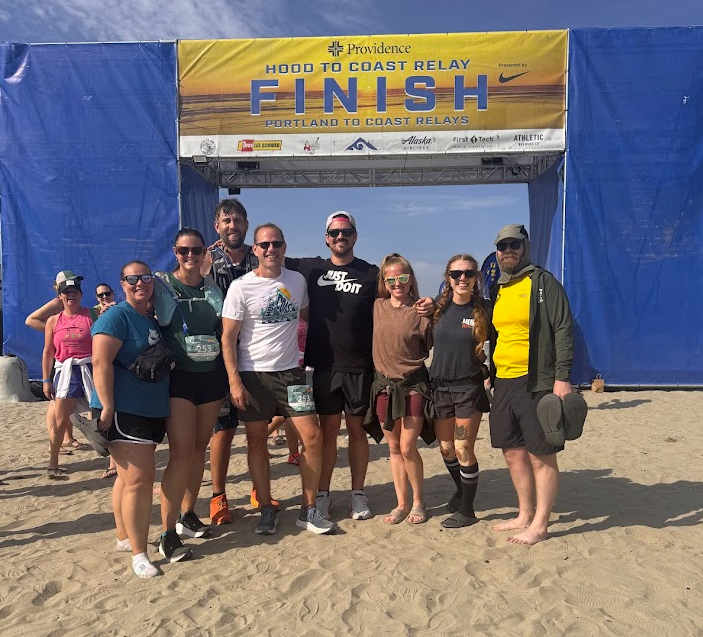
Finishing the 2025 Hood to Coast Relay
We finished in 34 hours. Our Team Captain, Jessica, led us through the finish line where we could finally grab our medals, go home, eat cheeseburgers or pizza or whatever we wanted, and finally take some showers!
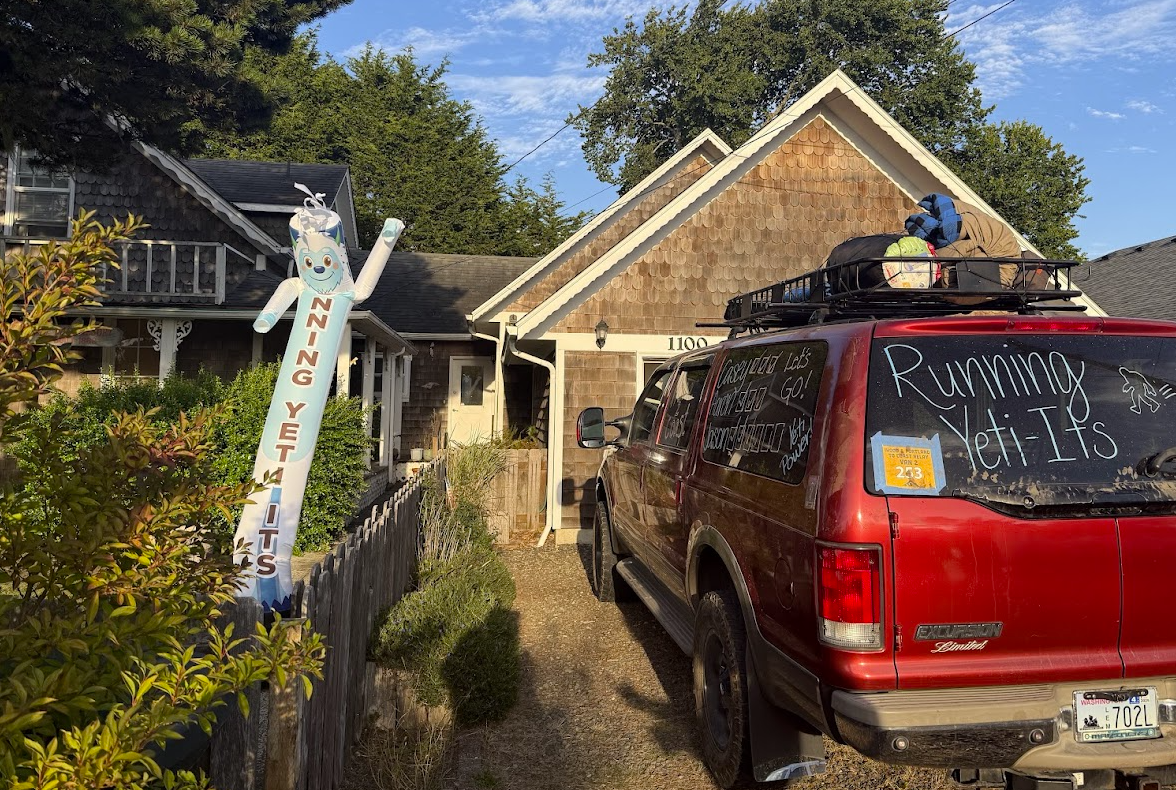
And then, of course, there was a wonderful welcome waiting for us at our family beach house. See the picture to the left for proof!

